Archive
Stoic Spiritual Exercises Cultivating Temperance
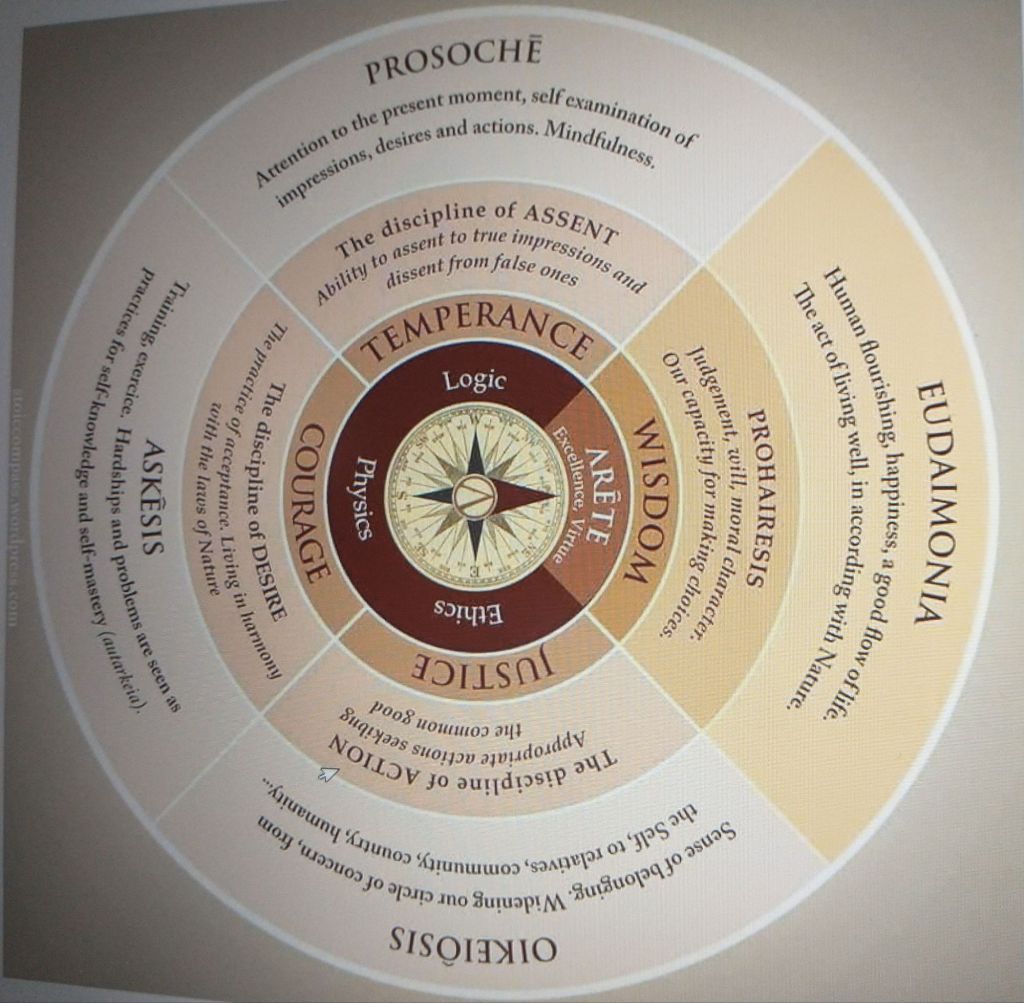
For the fourth week of spiritual exercises I completed last week I focused on Temperance. Stoics associated temperance with logic which got me to thinking. I am a longtime substance use disorder counselor and a lot of recovery work is rooted in learning to be honest: “I made a searching and fearless inventory”.
The discipline of assent is catching ourselves from making value judgements about things outside of our control. We learn that the only good is moral good. When an event happens it is only a terrible thing if we decide it is.
This honest assessment of reality is a path to freedom and living without fear. Dropping our inner deception allows us to grow in our ability to control our desires. We train ourselves to focus on what is in our own power and this allows us to do things we want to do and not do the things that we don’t want to do.
When we feel good about ourselves because we are taking right action then we are less susceptible to falling into unhealthy coping mechanisms.
Research backs up the stoic approach. Mindfulness work is an important part of treatment and recovery. Self discovery allows us to look at ourselves and see what the drivers of our self defeating behaviors may be.
I made a Facebook reel talking about Temperance which will work until 2/26/26 https://www.facebook.com/share/v/1BpDGBd8GK/
For the spiritual exercises I switched my coffee to black and was mostly vegetarian. I monitored my portion size and steered clear of fast food. I refrained from alcohol with the exception of a couple of drinks with a friend as I’ve been a bit under socialized. I also maintained my other exercises of physical exercise, daily justice work, and study and meditation.
It was a successful 28 days which has helped me focus and make concrete improvements. I plan to do them again in two years.
Stoic Spiritual Exercises: Cultivating Justice
I am beginning my second week of stoic spiritual exercises. My last blog post was about cultivating Wisdom: https://multiconstruct.blog/2026/01/07/cultivating-wisdom/
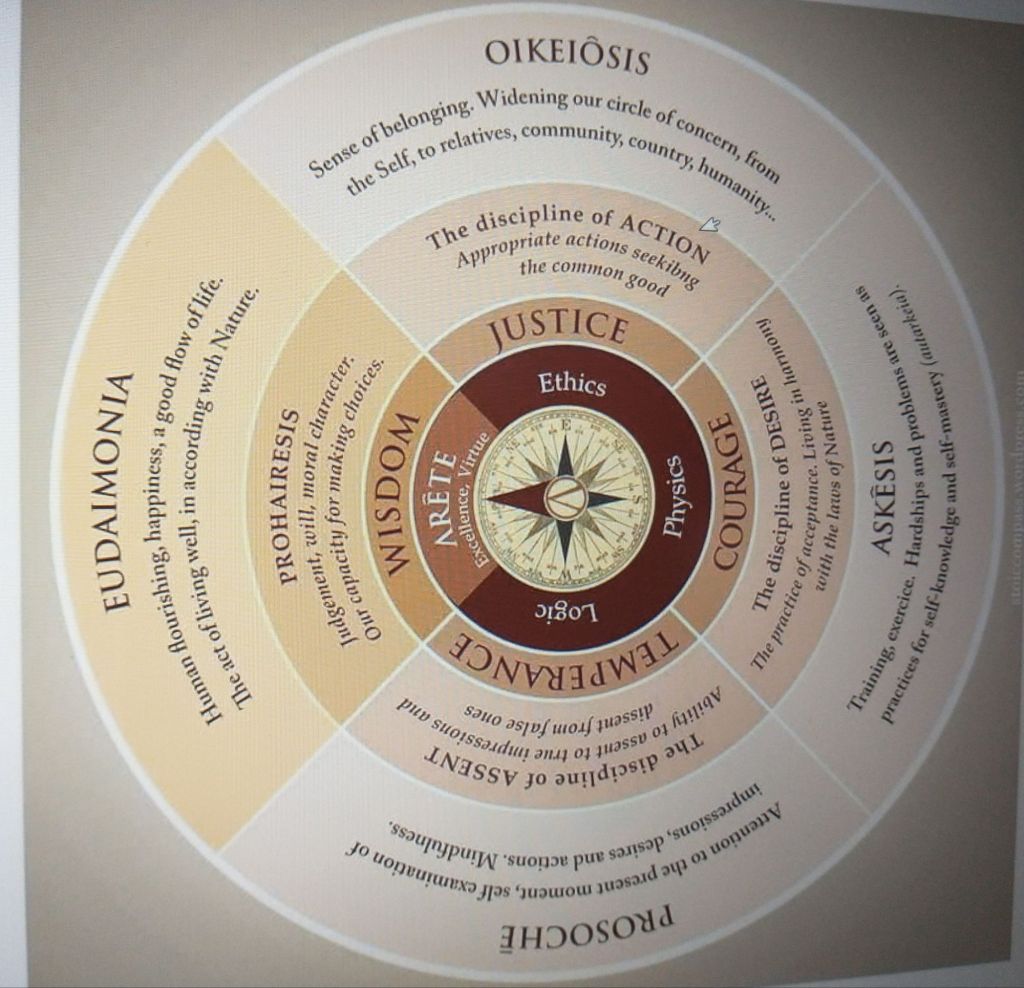
Justice corresponds with the discipline of action. Each of us has the power to choose to move towards a thing and to move away from a thing. No thing is in our power but that does not stop us from pursuing goals and trying to achieve.
Stoicism is powerfully rooted in the individual. Virtue is the only good and virtue is the exclusive domain of our own actions and opinions. All else we cultivate an indifference towards so that we remain free and have a happy flow of life.
When we act, we must act in accordance with nature. When we observe other living things we see that they take action to obtain food and shelter, procreation, and the rearing of children. Humans are no different but we meet our needs socially in cooperation with others. Acting in accordance with nature requires right living and consideration of others. Stoicism is rooted in cosmopolitanism.
Self awareness begins when we are toddlers but it is many years and much growth before we learn that other people are conscious as well. We call it the narcissist dilemma. My thoughts and feelings are real and important because I think them and feel them, and others’ thoughts and feelings are mere rumors.
As we mature we realize our parents have feelings and needs and are not just characters in our story but are the protagonists of their own narrative. The rest of the family, my neighbors, other townspeople, and personal associates are all the same. We bring this understanding to our state, country, and in its most developed state all the people of the world.
Beyond that we think of all the people of the future. We share the same resource base and the decisions we make impact their lives. I want to leave more of a legacy than resource depletion and micro plastics; waste, debt, and bullshit. I want to leave the children something good.
This is Justice. Weighing our own interests as co-equal with all others. We give primacy to the people in front of us for sure but we are all bound together in a collective web of reciprocity and shared habitat.
We have to take in information and make decisions with others in mind to live a life of justice. Right actions, done at the right time, for the right reasons is what it means to live a just life.
I did a talk on Facebook today if you want a deeper dive: https://www.facebook.com/share/v/1DvjEJ3Xgs/ It’s only going to be up for 30 days. If you like what I have to say but my book: https://breadandrosespress.com/products/the-practical-guide-to-building-a-better-world

Cultivating Wisdom
Today I kicked off 4 weeks of stoic spiritual exercises. I have framed the exercises around the four virtues: Wisdom, Justice, Courage, & Temperance. This week I want to talk about wisdom.
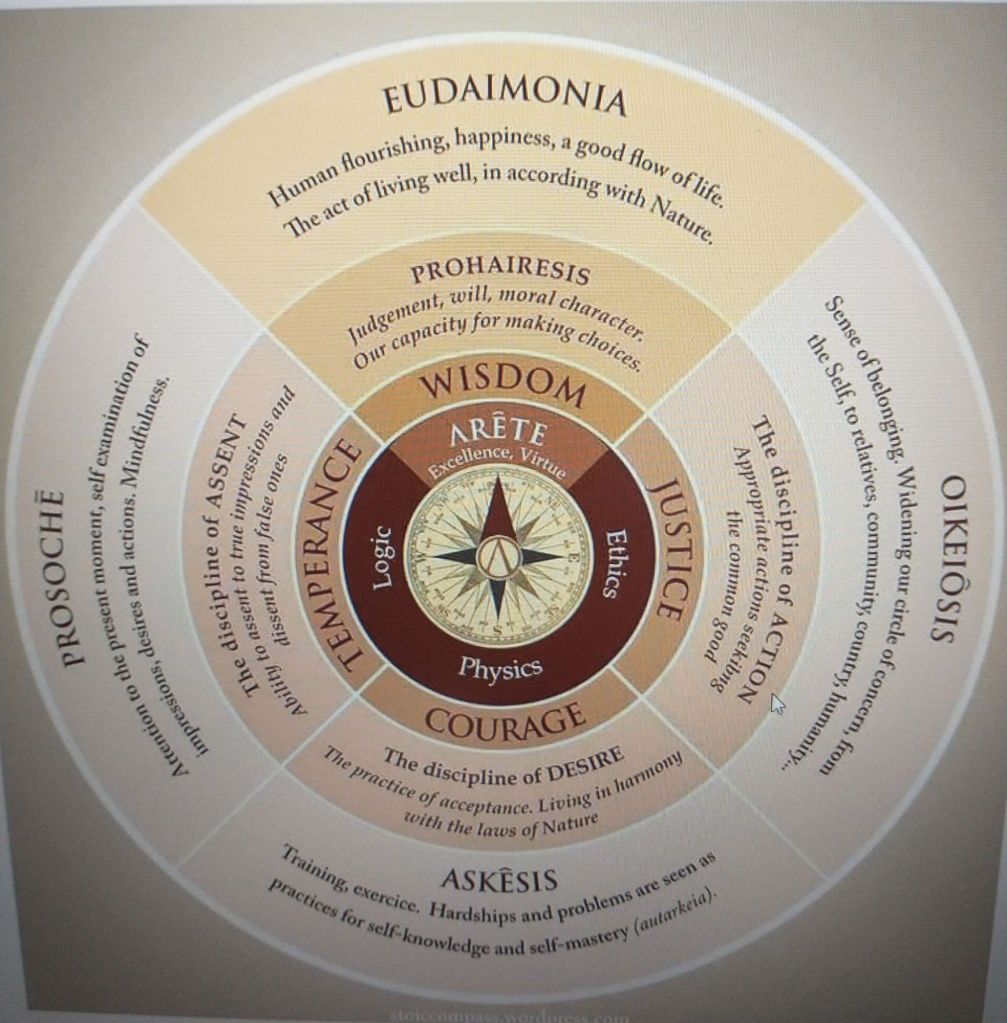
Philosophers get their name by being lovers of wisdom. Wisdom is not only knowledge but practical knowledge. Knowledge that informs our actions that allow us to be happier and more effective people. To exercise judgement and build our moral character.
Eudaimonia is a happy flow of life. It is living with purpose without being disturbed. Arius a disciple of Epictetus distilled his teachings into a small book called The Enchiridion.
The Enchiridion opens with: “Of things some are in our power and others are not…” Then he makes the definitive list of what those things are: Opinion, Movement towards a thing, Desire & Aversion or in a word, whatever are our own acts. Note, that no thing is in our power but the ability to strive towards a thing are well within our control.
Not in our power are the body, reputation, offices (magisterial power) and wealth, or in a word, whatever are not our own acts. Magisterial power has to do with holding an office or facing legal issues like going to jail or prison.
He goes on to talk about the nature of these categories. The things in our control are by nature free, not subject to restraint or hindrance. No one can force you to change your opinion or your goals, what you like and what you don’t like. These things alone are inviolate.
The things not in our control are weak, slavish, in the powers of others. Right living then becomes an act of categorization. Is this in my control or not. The wise person toggles between bravery and acceptance depending on the nature of the situation.
Epictetus then tells us what happens when we confuse what we own with what is in the hands of others: We will be disturbed, we will lament, we will blame both gods and men. The worst thing that can happen to someone is to be excuse ridden. If you don’t take responsibility for your life you can’t change it.
He also gives the promise that if your only concern is your own actions and you realize this is your only concern: you will blame no one, you will accuse no one, no one can compel you, and no one will harm you because you cannot be harmed.
You can take my car, slander my reputation, and jail my body. When I realize none of that is my true concern or an impediment to my will then none of that is really harmful.
So this week set a goal of self improvement. Take a look at the Enchiridion or Marcus Aurelius’s meditations. Put down the social media and open a book. Take 5 minutes for relaxation or meditation. Commit a helpful point to memory. Fall in love with wisdom all over again.

You can also follow my daily morning and evening meditations https://facebook.com/events/s/morning-meditation/1596039878200918/
https://facebook.com/events/s/evening-meditation/1433127815047245/
Spiritual Exercises
Greetings Faithful Readers and New Friends. It’s been awhile since I’ve posted. Someone attacked me on Facebook and brought up a blog post and referred to this humble repository as a little read blog. It has had its ups downs for sure, but I am working it more into my plans and you will see regular content through 2026. It promises to be a momentous year and I want to develop this leadership.
I’ve struggled a bit this year which curbed my joy and my productivity and my relationships more than I am comfortable with. I’ve taken a moment to reassess and identify what I’m bringing to the situations that are causing me trouble. To that end I am committing myself to 4 weeks of stoic spiritual exercises.
Two years ago, after stepping away from the directorship of a nonprofit I put together and implemented 4 weeks of spiritual exercises I developed while on an epic road trip through the Southwest. It cleared my palate of the stress I had been carrying and helped me develop the focus to both write and publish a book but also address my obesity and overall lack of physical fitness.

Two years previously, after completing my third term on the Columbia, Missouri city council I had gone on an epic road trip and completed a bastardized version of the spiritual exercises of Ignatius of Loyola, bookended by Crowley’s Book 4 exercises from part 1 (basically Buddhist meditation).
For those exercises they are completed 2-5 times per day with prayers and readings and 5 senses meditations (think visualization but with all 5 senses). Its ordered around the life of Christ as moral teaching and also involves colloquys (imaginary conversations with God, Jesus, and the Virgin Mary).
Most significantly it involves a conscience check. I used the time to work on my ego. Whenever I would note an egoistic thought I would touch my heart. Taking a month and focusing on the content of your heart and striving to be better is powerful. I see why the Jesuits do it annually.
I had tried them once before in the early 2000s while backpacking in Big Sur and was also profoundly impacted. That time I had powerful colloquys and I felt that if I continued down that path I would irrevocably break with consensus reality and that that was not being asked of me.
I wrapped them up after 2 1/2 weeks, called my dad and learned he was passing through Fresno and hitchhiked over to meet him for one last ride in the big rig. I correctly guessed it would be my last chance for a ride along with The Popster and it was. I’ve never regretted it.
The 2021 version wasn’t mystical at all. I’d had some of that during my COVID homelessness organizing and these exercises were more of an act of discipline and sober reflection. I “received” 2 messages: to get a job and live humbly and to make a small lifestyle change, which I did.
I came out of that a lot more keyed into philosophy and less interest in mystical experiences. I continued to deepen my study of stoicism and other ancient philosophies over the next couple of years.
I felt that I had gotten what I needed out of discipling myself to work humbly for a board of directors. I again thought a major life change should be road trip and spiritual exercises. I thought of reworking Ignatius’s system to stoicism.
I realized though that the stoics already had a system. Leaning heavily on Pierre Hadot’s What is Ancient Philosophy I organized them around the 4 virtues: Wisdom, Justice, Bravery, and Temperance.
I had morning mediations where I set goals for the day. Unread from primary texts: Epictetus’s Discourses and Enchiridion, Marcus Aurelius’s Meditations, and Musonius Rufus and nothing else. I also memorized verses for each virtue and used the Ignatian conscience checks.
Wisdom involved a focus on study and reflection. Justice emphasized pro social interaction and philosophical conversation. Bravery involved physical exercise. Temperance involved vegetarianism and rigorous portion control.
I grew more focused and disciplined and kept that self motivation through writing The Practical Guide to Building a Better World. With setbacks and gear shifting I again am called to take on spiritual exercises. This time, no road trip but to be made real in my home environment.
I am also going to open them up to the public as a shared project with my community. I will be posting about it here and there will be an IRL version in Leavenworth and an online version available everywhere. More details to follow and I’ll be looking to start early in the new year.
If you are interested in my book it’s not too late to get it before Christmas direct from my publisher. https://breadandrosespress.com/products/the-practical-guide-to-building-a-better-world
Keep following for details as well as my traditional Holiday Letter coming soon.
Blessed New Years
I was blessed to ring in the new year with my fiance in our new home. We closed Thanksgiving week but it’s her busy time at work and we traveled to Michigan/Ohio for the holidays so we didn’t get to move in in earnest until December 30th.


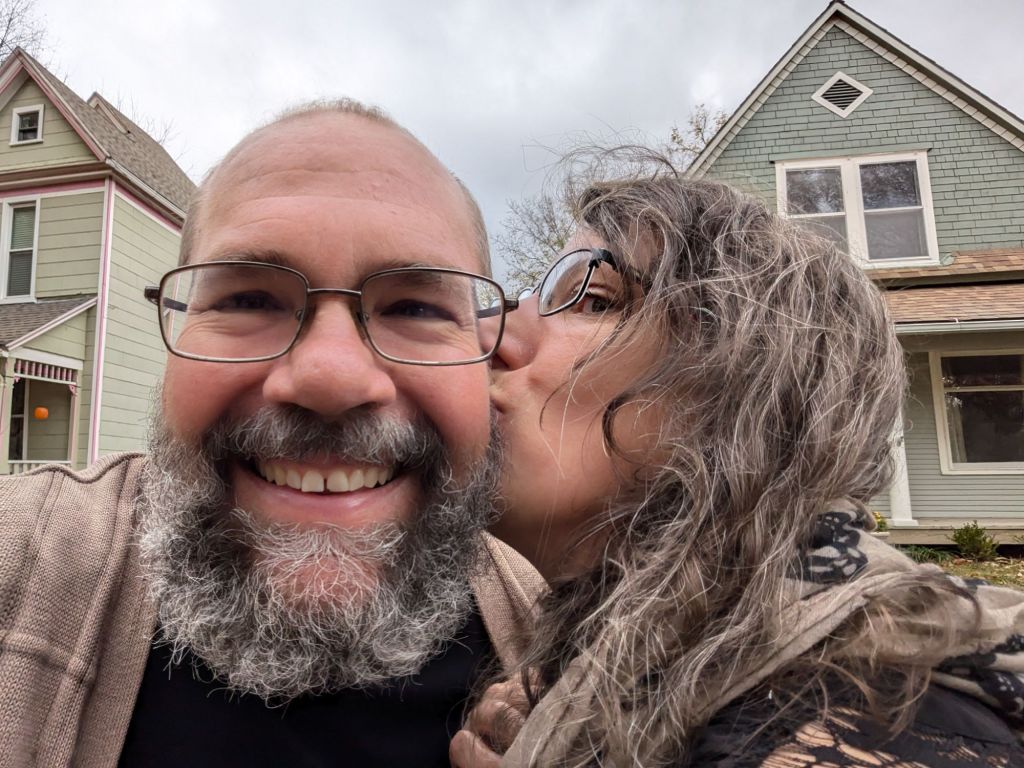
It was a lot of work with us and the two teenagers but we pulled together nicely and got it done in time to kick back a little and enjoy the new year coming in. It was nice to only have to get out of bed two minutes before the new year for my sparkling juice toast and sweet kiss and I was back in bed before 12:02 when I got a Happy New Year text.
Moving and setting up house in a new relationship brings a lot of changes. One of the things that brought my partner and I together was a commitment to sustainability as part of our values.
Shae was a single mom but still really on it as far as recycling. Her oldest is into cooking and has done a lot of research on nutrition and learning to make healthy food versus ultra processed stuff. Being able to support and build on all that has complemented my long interests in what I would call right living, using moral reasoning to choose the best course of life considering sustainability, justice, and neighborliness.
Writing The Practical Guide this year has sharpened my interests in areas I’ve lagged in like personal health. Having a chapter on lifestyle as an instrument of change means you have to eat and exercise to optimize for health and avoid medical intervention. So I’ve done that to good effect.
With helping my partner through a difficulty, house hunting and then moving, starting a political action committee and completing a manuscript and seeing it through publishing has been a lot. Through it I’ve recycled, minimized my food waste, made real food at home for the family, and all the other right living tasks I could reasonably pull off.
When I’ve had to I’ve grabbed the fast food, skipped the gym, or made some other compromise with my overall values to have a smooth flow of life. You don’t have to mail it every time to get a comparable impact but not stressing over that last 10% that would take effort beyond my abilities.
I elevated for a couple days to get the move done and worked harder than I should. I cut a few corners though to make it a bit easier. My brother John says “Most moral choices are between the right thing and the easy thing.”
I want to work hard for a better world and for my family but I also want to take the time for self care, companionship, kindness, and especially whimsy when it can be found.
What are you doing to be happier, healthier, or more sustainable in 2025? I’ll be blogging everyday through Bloguary. Look for an update on #freeKevinBromwell and as January 6th approaches I’ll be talking about the County Party Initiative for the New American Community. Stay warm constant reader.
Ethics of Integrated Care
As a long time social services provider, clinical manager/trainer and administrator I have been doing my own trainings to maintain my Co-occurring Disorders certification for a long time. I have a strong interest in philosophy and have spent some time with a lot of primary texts.
The ethics trainings I have attended have not been very informative or helpful and have been focused a lot more on CYA (Cover Your Ass) and agency policies than actual training on ethics or even morals. Discussing scenarios is not as engaging as the real ethical scenarios that come up on almost a daily basis doing the work and managing those delivering services.
Since COVID raised it’s bumpy little head I have not been at an agency that has staff that need 6 hours of ethics training or wanted to gather up folks who need the training as a consultant. Last time I did self study and read and reflected on Stoic ethics. I had planned to work my way through some of Epictetus’s Discourses but I left it at home while I’m away from the office getting my van repaired.
I thought instead I would distill some of my ethical thinking in an extended blog post. My post career plans are to write a book “A Practical Guide on Building a Better World” distilling my lessons learned in social services, activism, politics, policy making and living an ethical life. A section on ethics will be a must.
My thinking on ethics is rooted in a big handful of thinkers, writers and doers. In no particular order I want to acknowledge Lou Marinoff author of “Plato Not Prozac” whose chapter on ethics I found transformative and made me a Multi-Ethic Relativist. I was fortunate enough to work with another PhD philosopher Brian Bowles who taught me the difference between boundary crossings and boundary violations.
My brother John Trapp has been an invaluable collaborator. He followed MLK to Gandhi to Tolstoy to the ancient Greeks. As a true Epicurean he nonetheless turned me on to the Stoics, most importantly my man Epictetus and the inimitable Marcus Aurelius. Of course I couldn’t leave ethics without acknowledging Jesus, primarily the Sermon on the Mount Jesus who launched me on a path with his simple admonition to “love your enemies and pray for those who persecute you”.
Since you’ve read this far, you deserve a photo. Here is the aforementioned John Trapp in front of Turkey Creek on last week’s hike.

The first question to ask is why ethics? With a myriad of ongoing training needs why is ethics the only one required by name? The reason ethics is required is so that professionals don’t have sex with their clients. It is perennially the most common reason professionals lose their license or certification. I’ve seen it again and again throughout my career. To say it plain, never have sex with a client.
When we elicit feelings in clients we call it transference. Freud identified it as the driver of the therapeutic change process. Counseling, if you do it right is almost all listening with total attention. What is sexier than that? But it’s not real. As a helping professional you are not presenting your unadulterated authentic self but you are being paid to provide a service which involves activating the best part of yourself to help another primarily through supportive listening and empathy. Your client is not in love with you. They are in love with an illusion.
When clients elicit feelings in us that is called countertransference. It is normal and should be expected and needs to be managed. Clients will stir up all kinds of feelings in us from frustration, anger, sympathy, admiration and even love. No feeling is wrong, only actions based on those feelings. Having good supervision or peer support is essential to navigate the tricky waters of countertransference.
Now that the most essential point is made we can move on to defining our terms. Ethics is a system of thought that determines how to make moral judgements. Ethics is the system and morals are what we do. The powers that be should really mandate morals training instead of ethics training. As clinicians, supervisors, administrators and policy makers and even just as humans we are constantly using moral reasoning to navigate ethical dilemmas.
One of my favorite John Trapp quotes is “Most ethical dilemmas are choosing between the right thing and the easy thing”. This point helps us to make the distinction between justification of our choices and actions and rationalizations of our choices and actions. We all have a strong bias for the path of least resistance. Lou Marinoff points out the root of justification is in justice. That is why we need to have intelligible ethical systems. Lost people wander downhill.

There are lots of ethical systems and they all have some value and they all have weaknesses, blindspots and contradictions. Lou Marinoff recommends using multiple systems for moral reasoning. Some fit better in some situations and sometimes looking at issues from multiple perspectives. He calls this approach Multiethical Relativism. Let’s look at some systems and what they offer.
Most folks get their ethical system from their religious background. That is fine and works for most people most of the time. The golden rule appears with slight variation in a large number of religious traditions.
In Buddhism they identify a concept called Ahimsa which means do no harm. It’s the first part of the Socratic Oath. As I learned from Brian Bowles both the left and the right hold a do no harm ethical basis, it’s truly a universal ethical principle. Where the right and the left diverge is the right holds a purity ethic as well. From borders, language and culture; to defined gender roles, and a respect for “life” folks in the right sometimes see the purity ideal trumping the limiting harm ethos.
Ahimsa is a great foundational ethical principle. There are other systems. Utilitarianism holds the most good for the most people. It has some moral value though it can easily be taken to perverse extremes with simple thought experiments. Here’s a nice comic illustrating it’s downside. https://existentialcomics.com/comic/494
Utilitarianism does have some good practical applications especially in group living situations. Sometimes the ethical choice is not in a particular client’s best interest. For the good of the group, the integrity of the program or for the safety of other participants and staff it can be ethical to discharge someone for example even if it’s not best for them.
When I was a young clinician I always gave my best effort for the person in the room and didn’t hold back. I was proud when I had successful outcomes in difficult cases and was not afraid to go the extra mile. I also didn’t pace myself well and would burn out. I saved my ducats though and so I would resign with notice and go backpacking or hitchhiking around the country until I healed up a bit and then throw myself back into the grind. Had I not been in a place to do that it would have been ethical to do a little less, better project my energy and personal well being and stuck it out for the long haul.
Another example is thinking about the clients you are going to serve in the future. I remember in my first social work job I was working with a sweet little old grandma who had her 2 grandkids (a boy and a girl) placed with her in a dilapidated one bedroom apartment. She had moved into the living room but Protective Services had issues with a bit and a girl sharing a room.
I worked the local housing authority to get them fast tracked and vouched for her without completing my due diligence. Turned out Gramma had a felony for operating drug house. Not only did I not get her in public housing I never got anyone in public housing ever again. On a positive note I had helped clean and paint the apartment did some other minor repairs and ran a curtain across the bedroom as a Plan B and it passed inspection and she kept the kids.
Even more than utilitarianism I find value in virtue ethics. As a student of sociology I learned about roles, status, and master status, the role that singularly defines us. Most women take their master status from relationships, wife and/or mother are common. Most men from their employment. I have never wanted to be defined by job or career or relationship and chose my master status as, a good person. So I naturally turned to virtue ethics that hold that virtue is the only good.
When faced with situations that challenge our equanimity we need only ask which virtue do I need to call on. When you can say, “thank goodness I ran into that really annoying person because it gave me the opportunity to practice patience” nothing bad can ever happen to you.
Virtue ethics requires us to define what is good. Fortunately Marcus Aurelius has done that for us. I’m going to share a larger meditation because it is a good one.
“Begin the morning by saying to yourself, I shall meet with the busybody, the ungrateful, arrogant, deceitful, envious, unsocial. All these things happen to them by reason of their ignorance of what is good and evil. But I, who have seen the nature of the good that it is beautiful, and of the bad that it is ugly…”
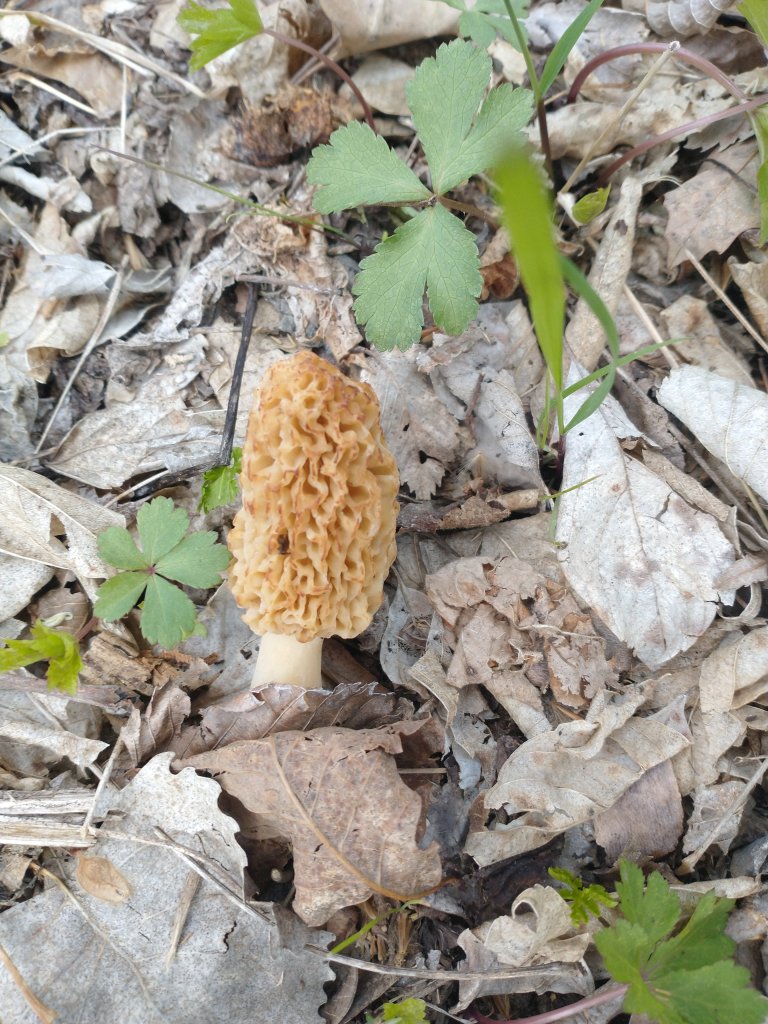
For Marcus Good, Truth and Beauty are all synonyms. As a policy maker my moral framework of decision making was whenever possible we should move forward in the most just, beautiful, sustainable and equitable way. When that option is not on the table, and the utopian ideal rarely is, I would then factor all the possible options including doing nothing and support whichever was the least terrible and that set the stage for better choices in the future. Time for another picture.
Few clinicians and direct service workers are philosophers. We just need to have a few perspectives down in order to have highly functional moral reasoning. The work gets most interesting and the most dangerous not when we are choosing between the right thing and the easy thing, that is simple even if hard. Moral reasoning is most fruitful when our ethical principles are in conflict. When there are no easy choices but carefully balancing competing interests and moral precepts.
It’s less important to definitely answer the great questions, like is morality absolute or is it relative to the culture and times that you live in. In the helping professions we are not engaged in an intellectual exercise but making choices that can literally be life and death.

One important ethical consideration is boundary crossings versus boundary violations. Boundary violations are moral failings that are always wrong no matter what the circumstances. Exploiting clients financially or sexually or using them to meet your own emotional needs are all examples of boundary violations.
Boundary crossings are different. They are a step across clearly delineated lines of separation between staff and people being served. It might be socializing, accepting a gift, taking someone to a holiday gathering or a support group meeting which you might attend anyway. Going to funerals or weddings or other celebrations. The myriads of things we do with our friends and family that we don’t do with our clients.
Boundaries are an important part of professional life as dual relationships are frought with peril and ambiguity. A good boundary crossing is done for a therapeutic reason and is discussed with your supervisor or peer accountability partner. Having that second set of eyes is an important safeguard.
Here is an example in case I’m not being clear. I had a long-term counseling relationship with a fellow I’ll call Mark. Mark was old school,of Irish descent, and a larger than life character. He made a lot of breakthroughs in our work together after struggling with drugs and alcohol for a long time. As our work progressed he started mentioning and then insisting that we share a meal together. For Mark us sharing a meal was an acknowledgement of our equality and a recognition of our common humanity. So towards the end of our work I checked in with a peer manager and took Mark to lunch. It was an important thing for him and helped him be OK with moving from our formal supports to relying on the informal supports of the recovery community.
After he was out of services he connected with me on social media. My policy is not to solicit online relationships with former clients but to accept them if I’m comfortable with it after they have completed services with me. Mark stayed in touch and I saw him continue to do well. Many years later he invited me to lunch at the restaurant he worked at. I was serving on City Council at the time and he wanted to show off his important friend and show me that he had made it.
After giving Mark a ride or two to the store I briefly became his paid caregiver when he developed a terminal illness. Throughout our post therapeutic relationship I was cognizant that the therapeutic relationship goes on forever but nonetheless a more reciprocal friendship type relationship developed. To do nothing else would have been to label Mark a second class citizen forever.
When we conflate boundary violations with boundary crossings we close the door to activities that can enhance the therapeutic relationship and add meaning and depth to our own lives as well as a greater sense of community. Many agencies and supervisors preach so hard against dual relationships out of an excess of caution and a lack of recognition of the full humanity of those served.
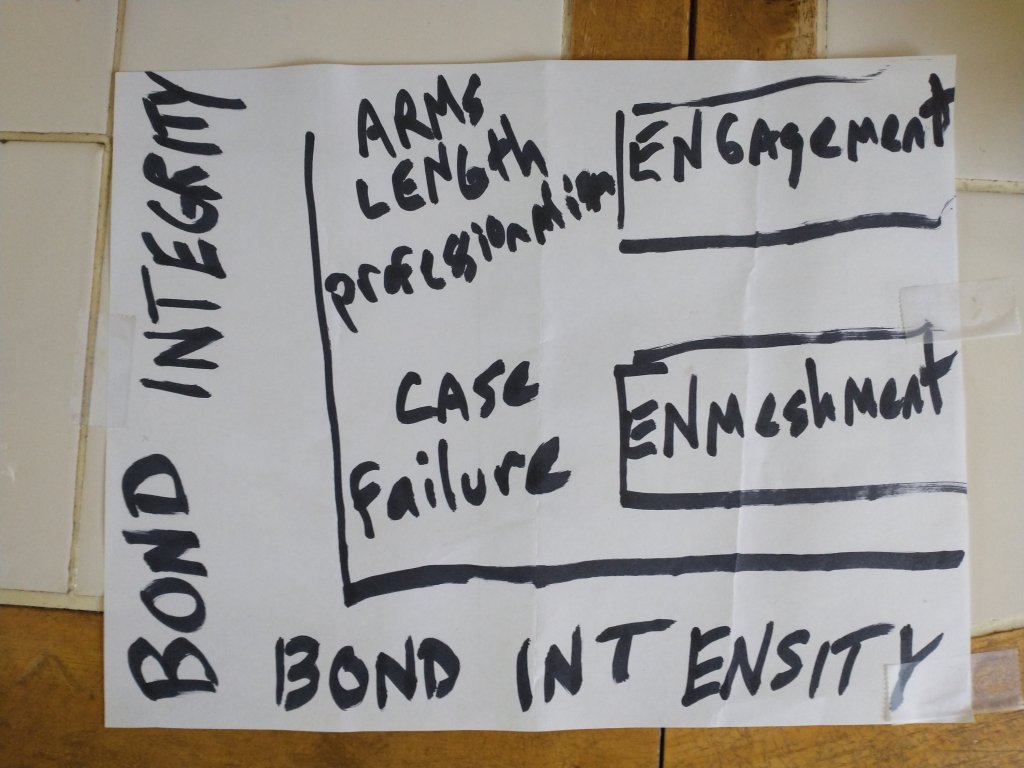
I developed a diagram to make this point. We have two axes, one is bond intensity (the strength of the staff-client relationship) and the other is bond integrity (the morality of the staff-client relationship). With high bond strength and a high moral compass you have engagement. Engagement comes from mechanical engineering, you engage a clutch for example. Even though the gears are separate they interlock and movement happens.
With a high bond intensity without equally high integrity we get enmeshment. The clinicians feelings are wrapped up in the client, there is an unhealthy connection that leads to poor outcomes and increased risk to the client and/or the agency. It is fear of enmeshment that drives most ethics trainings and policy manuals which unilaterally ban innocuous or even beneficial boundary crossings.
With high bond integrity but low bond strength we get a lot safer for staff and agencies but at a cost to efficacy and really helping people. I call this Arms Length Professionalism. Some people are going to get better but they probably would have gotten better without your help as well. With neither bond integrity or bond intensity you most likely get case failure. People quit showing up or get discharged from the program. Here is a poorly drawn chart to illustrate the 4 quadrants:
My final advice is engaging and acting your moral reasoning is also based on where you are in your career. If you are new in the helping professions stick close to agency policies and procedures and written ethical guidelines. Make your mistakes in the “Arms Length Professionalism” quadrant. Ask questions, seek advice.
As you grow in the work you gain greater ability to bring nuance and flexibility to issues. To seeing beyond the immediate to long-term issues and more effective ways to successfully engage clients to create a climate of better outcomes while avoiding the pitfalls of enmeshment.
There are bright lines though that should never be crossed regardless of how long you have been in the field. I worked on a psychiatric unit right after I got my BS degree. There was a 16 y/o girl who had been sexually assaulted who did not want to visit her father. She escalated and the charge nurse told me to take her to the “quiet room”.
I deescalated the situation and she agreed to stay calm. The charge nurse insisted, I resisted and she threatened to write me up for insubordination. I drug that poor girl to the “quiet room” and still feel the shame 30+ years later. I should have stood my ground and let the chips fall where they lay.
Your moral reasoning and your identity as a good person are some of the most sacred things you have. Protect them, grow them, teach them and let them carry you into a place of peace and efficacy.
 Multiconstruct
Recent Comments