Archive
Notes on trauma, inclusion, & Children’s Protection Services
I am attending the Crime Victims Rights Conference in Wichita. It has gone paperless and I left my notebook in the car so I am preparing a blog post as a vehicle for notes. Lots of stuff on trauma, I hope they get beyond the basics. They didn’t but a few gems amongst a lot of very basic programming. Glad it’s over. Don’t recommend.
The four R’s of Trauma: Realize, Recognize, Respond & Resisting Revictimization. Trauma Informed shifts from what’s wrong with you to what has happened to you.
Defensiveness and resistance can be signs that we are ready for growth.
Gossiping is a form of numbing, points to need to have better outlets for trauma. Proactively address healthy conflict resolution and look at workplace gossip through a trauma lense.
The success of an intervention depends on the interior condition of the intervenor. Autonomy and freedom are more important than safety. Accountability is support. It needs to be encouraged and rewarded.
Cultural competence is better termed cultural relevance or cultural humility. Diversity, Equity, inclusion & Belonging. They are progressive steps. Individuals are not diverse. As a group we are diverse.
We have to look at who we serve and who we are not serving. Who is in our community? Who is already serving that community? Who are served, inadequately served, not served? How are people’s identities influencing their experiences and outcomes?
Belonging is when folks with a marginalized identity can bring organizational authority and be themselves. For a team member we can push back on systems and ensure a safer place to land.
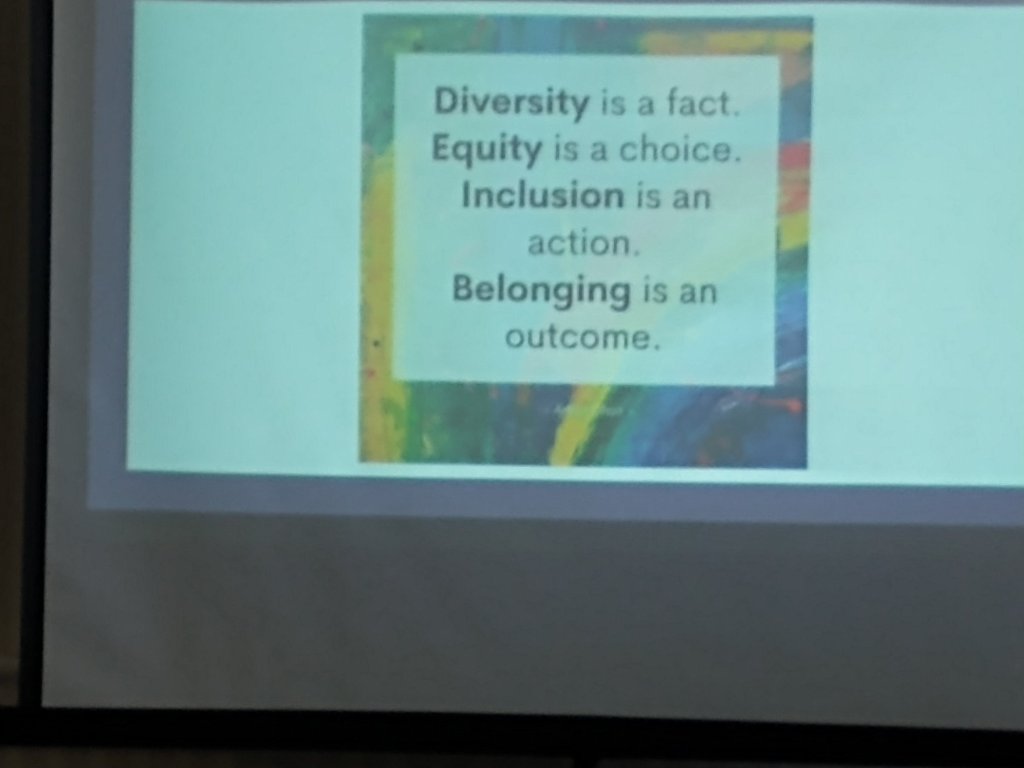
I will add to job ad: Members of marginalized communities are strongly encouraged to apply. A false sense of urgency is a white dominant value move to flexibility and realistic work plans.
Are you a mandated reporter should be an interview question. 51.5% of reports are screened. 76% neglect, 16% child abuse, 10% sexual abuse. 82.9% of prenatal substance exposure were screened in. 18% of reports are substantiated, 13% receive an alternative response. Law enforcement, educational personnel and medical personnel are top reporters.
Black folks are screened in at twice the average of whites. Children with disabilities screen in four times higher. There is an overutilization of child welfare system. Most situations can be resolved without child protection intervention. Mandated reporting does not lessen child maltreatment rates nor does it reduce future rates.
Poverty is not neglect. The indicators look the same. Thinking of neglect “when reasonably able to do so”. “Reason to believe” is in most statutes and creates a subjective standard allowing reporters to think critically.
Protecting children is everyone’s responsibility. Child Protection is a government agency that does not address the situation very well. Making a call and then not thinking about what happens is not good ethical practice.
We were unable to find any high-quality research studies suggesting that mandatory reporting and associated interventions do more good than harm. Supporting caregiver/child relationship is the biggest factor in ameliorating Adverse Childhood Events.
Studies of risk assessment of children being left alone showed it was based on moral approval or disapproval of where the mother was. 50% of black mothers will have a CPS report before their child is 18.
Trauma Bond: captivity brings long contact with coercive control. Goal is the fear of death and gratitude to be allowed to live. Attachment is the rule not the exception.
7 stages of trauma bonding in relationships: Lovebombing, Gaining Trust, Shift to criticism and devaluation, Gaslighting, Resignation and submission, Loss of sense of self & emotional addiction. , If
step one part 1
Introduction:
I’ve had the great pleasure to get to teach the 12 steps of recovery, specifically Narcotics Anonymous over the past year or so. I am a treatment person not a recovery person so I do not usually presume. The Steps are supposed to be worked by a Sponsor. Someone experienced in The Program who has worked the steps themselves. For people with multiple challenges Recovery can be an arduous path and unique accommodations must sometime be made.
If an individual speaks only a foreign language or is deaf and only speaks sign both NA and AA graciously make interpreters available but only for meetings not to meet with sponsors. Using deaf as an example you also have the unique challenge of concrete thinking, translation, and lack of all reference even through metaphor for hearing. I just looked the steps on line(cyber recovery) and translated. And its been cool. One of the most interesting therapeutic approaches I’ve ever tried. Has made me really have to understand the text.
Someone requested I write it down for them. I told them it would be a lot of work but it may be of general interest so I would share it.
Step 1
“We admitted that we were powerless over our addiction, that our lives had become unmanageable”
Not understanding the first step makes people use drugs. Addicts have other problems besides using drugs. People in NA can only help others by caring about them and living life as it is not how we want it to be or fear it to be. NA just focuses on not using drugs.
Using drugs makes you selfish and step one helps that. If we are powerless we don’t have to stick up for ourselves or try to do stuff we can’t do. When we used drugs we tried to hurt ourselves, not because we wanted to but because we were sick. Our sickness is because we can’t remember what has happened or learn from other people. We lie to ourselves and can’t see how things are. Sometimes people wait to make decisions until they’ve been clean awhile and they’re better. Recovery is confusing in the beginning and waiting to make decisions helps. We can’t do that forever as we get better in recovery if we want to grow.
We can’t give it up to God without understanding other addicts. We do what other addicts who have been clean longer suggest. We read, study, and ask questions when we can. We share with others so we don’t plan to use drugs. We try to understand we are sick and can’t get better alone. The most important word in the first step is We. “We admitted we were powerless over our addiction and our lives have become unmanageable”. We are not alone we are in a group in NA. We don’t have to do this step alone.
When we were using drugs we felt the strongest when we were making our biggest problems. Sometimes it almost killed us and ruined our life. We thought we were strong but we could just make people do stuff we wanted. Other times we felt weak and nervous. When bad things happened we would admit we have a problem and things would get better. “We admitted we were powerless over our addiction and our lives have become unmanageable”. Then we can keep getting better forever, unless we decide we’re powerful.
Most ask “Tell me how it’s done? Show me what to do. I am afraid to try.” In NA we see people like us who have gotten better. We wonder if they are like us how can they do good? They do things we don’t think people can do. As we get better we learn that how it was when were using isn’t that way anymore. We are no longer dazed by drugs. We have meetings to go to. We learn new positive thoughts.
We learn to catch ourselves and slow down before getting caught up in things. Almost anything, even important things can wait five minutes. Taking time to think doesn’t mean we can’t do some things. It helps us not to feel hurt. Sometimes we don’t have to do anything and we can give it to God. Then we think of good things to do, people to call, and good things happen when we pray.
Some things remind us of drugs. Sometimes it does and we don’t see it and we don’t know why we want to use drugs. Some people make us think about when we were kids or when bad things happened or like they are the cops and we want to get away. This keeps us from getting better. Learning more about what reminds us of stuff lets us change it. Intense anger, fear, or shame for no reason shows you have a problem. We have to give everything in our life to God. When we remember we are not in control problems go away. Without giving it to God we can’t get better and we will do what we used to do. Part of giving it up to God is remembering we made our lives small. We did bad things and bad things happened. We get confused because we did drugs and need other people to help us. All addicts feel nervous sometimes but they help each other.
We have to look at what we do in recovery. We do stuff for a long time and we don’t think about it. We don’t remember why we do stuff we just do it. The longer we are in recovery we can do things better. We ought to think about what we do especially the stuff we were doing when we were using drugs. They make our life like it used to be. We are afraid at red and blue lights because of the cops but we aren’t breaking any laws and don’t have to be afraid.
######
had hoped to finish but will call this part 1. The steps can seem daunting but they are front loaded with length and depth. Most of it is really clear. Occasionally I am lost by a thought. In talking with a translator I was told “clarity” was the essential quality. I am curious of what people who know this material better then I think. I enjoy abstraction but its been cool to lay it down for awhile. In the concrete there is room for God but not a Higher Power. If the New York Times said God is dead in the 60s for this exercise Higher Power is dead killed by vagueness and abstraction.
 Multiconstruct
Recent Comments